Paper: How Fast Do DNS Filters Block Fresh Phishing?
PREPRINT · NOVEMBER 2026
How Fast Do DNS Filters Block Fresh Phishing? A Seven-Day, Three-Vantage Comparison of Quad9, Cloudflare 1.1.1.2, and Public Blocklists
Abhijeet Apsunde
Read the paper · PDF · DOI 10.5281/zenodo.24098122 · Code and data · CC BY 4.0
Summary
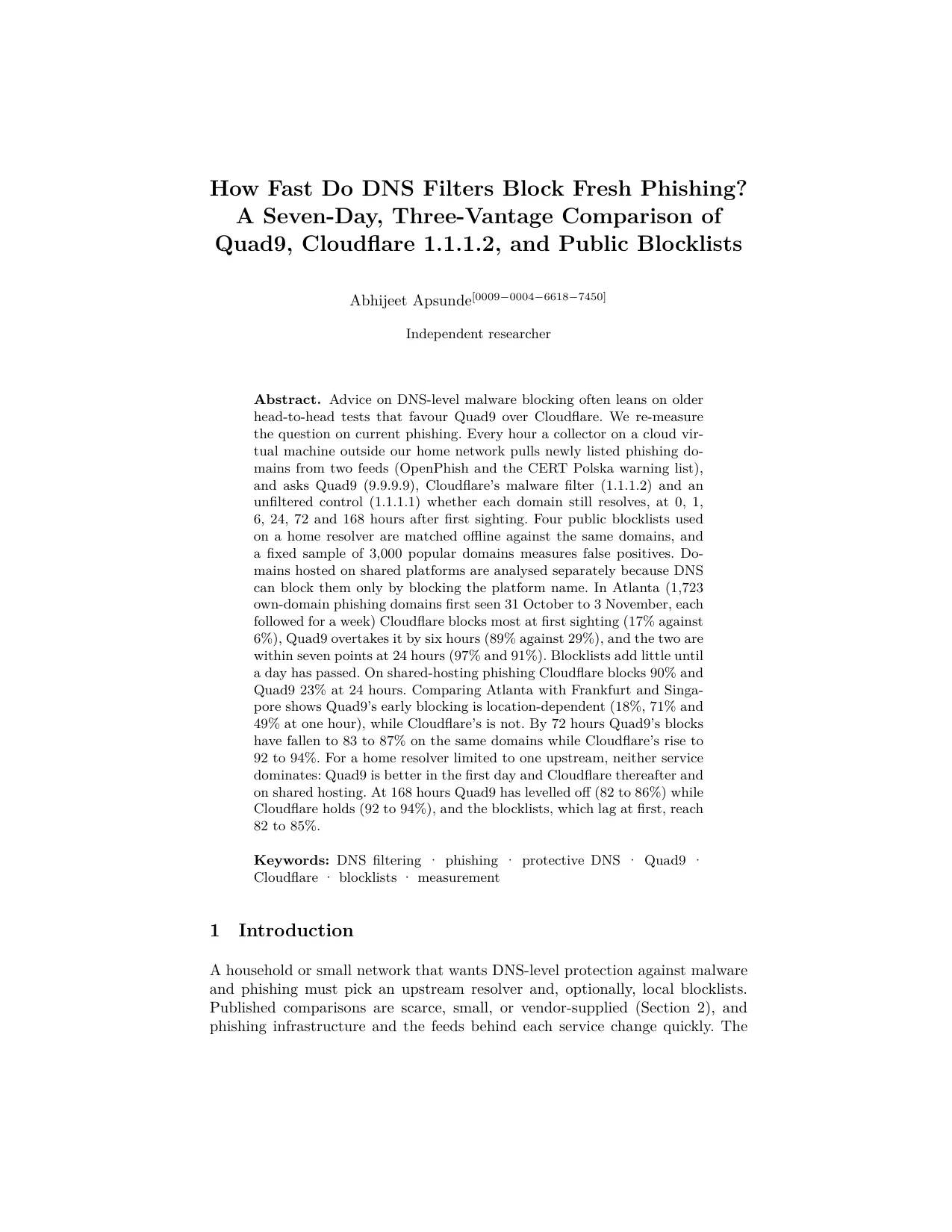
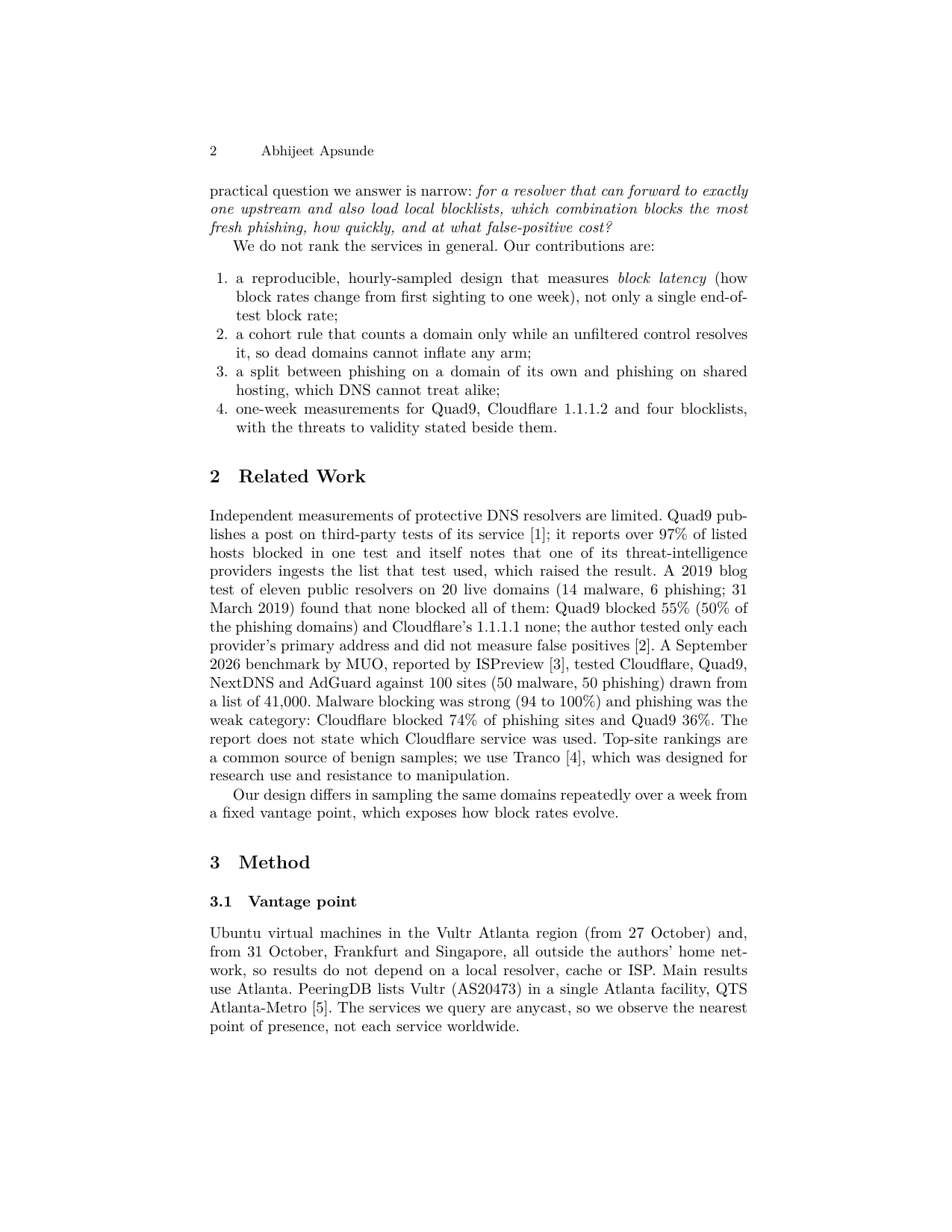
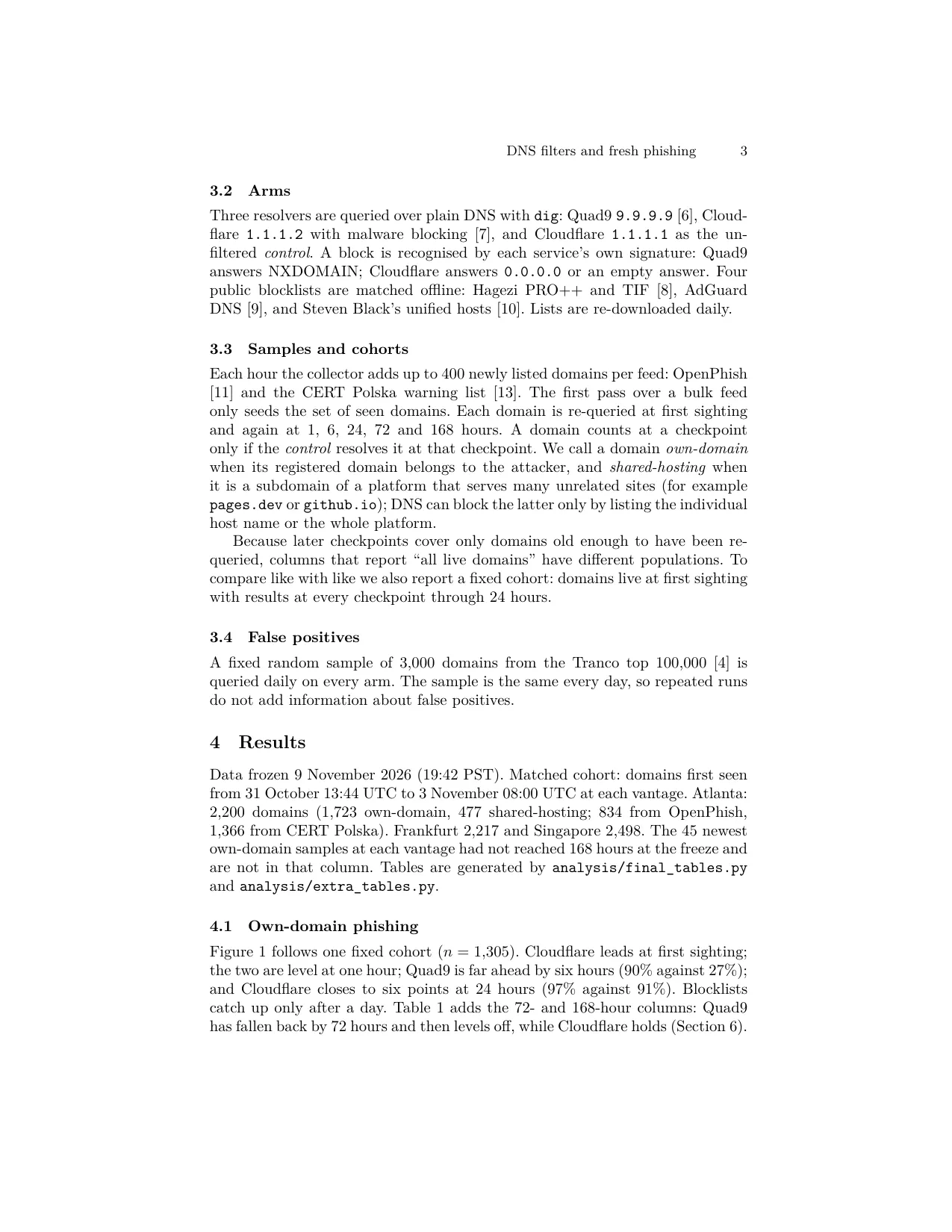
A home resolver can forward to exactly one upstream, so choosing between Quad9 and Cloudflare's malware filter (1.1.1.2) is a real decision, and most advice on it rests on old tests or on the vendors' own numbers. I measured it on current phishing. Every hour, a collector on a cloud VM in each of three cities pulled newly listed phishing domains from two feeds (OpenPhish and the CERT Polska warning list) and asked each resolver whether the domain still resolved, at first sighting and again at 1, 6, 24, 72 and 168 hours. A domain only counted if an unfiltered control resolved it at that checkpoint, so dead domains could not inflate anyone's score. Four public blocklists that a home resolver can load locally were matched offline against the same domains.
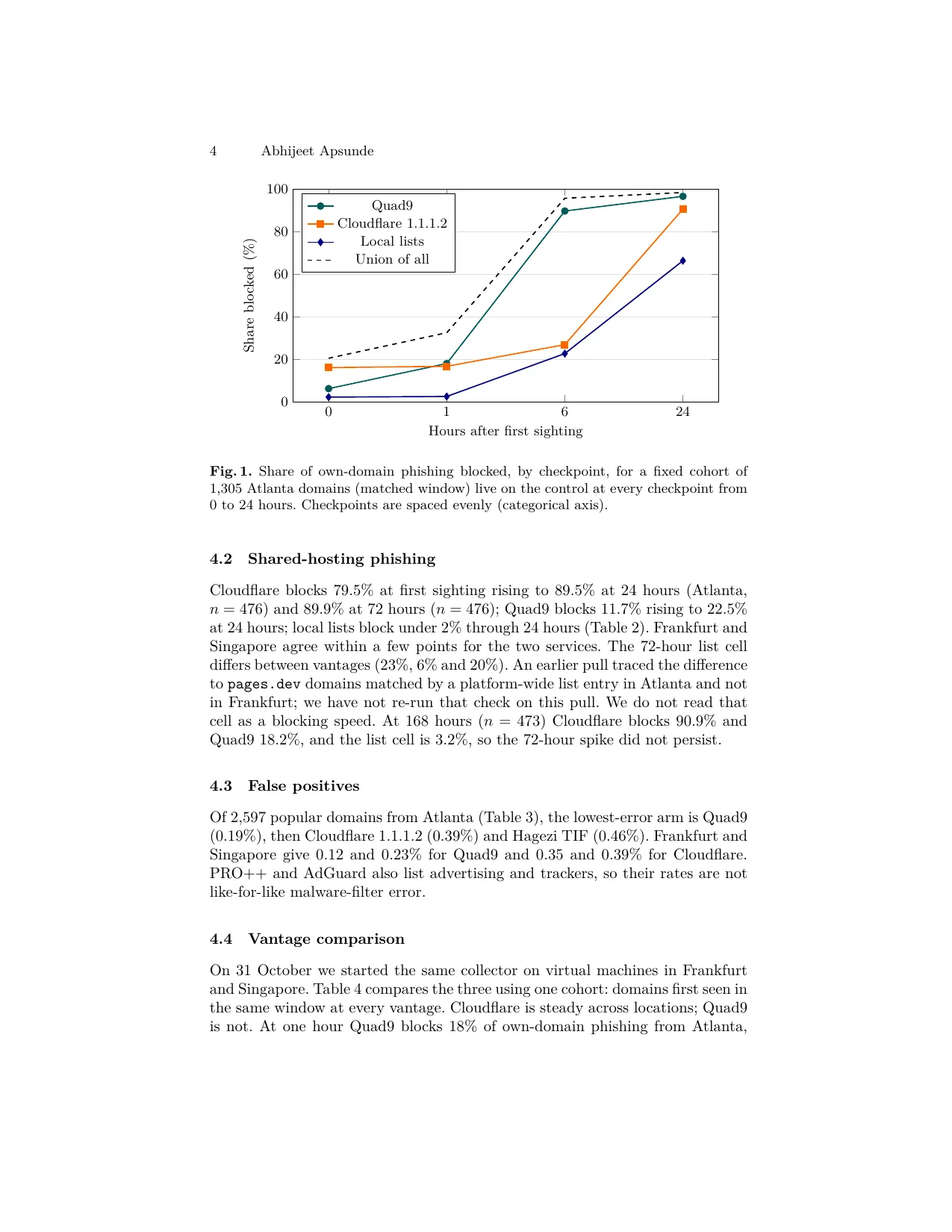
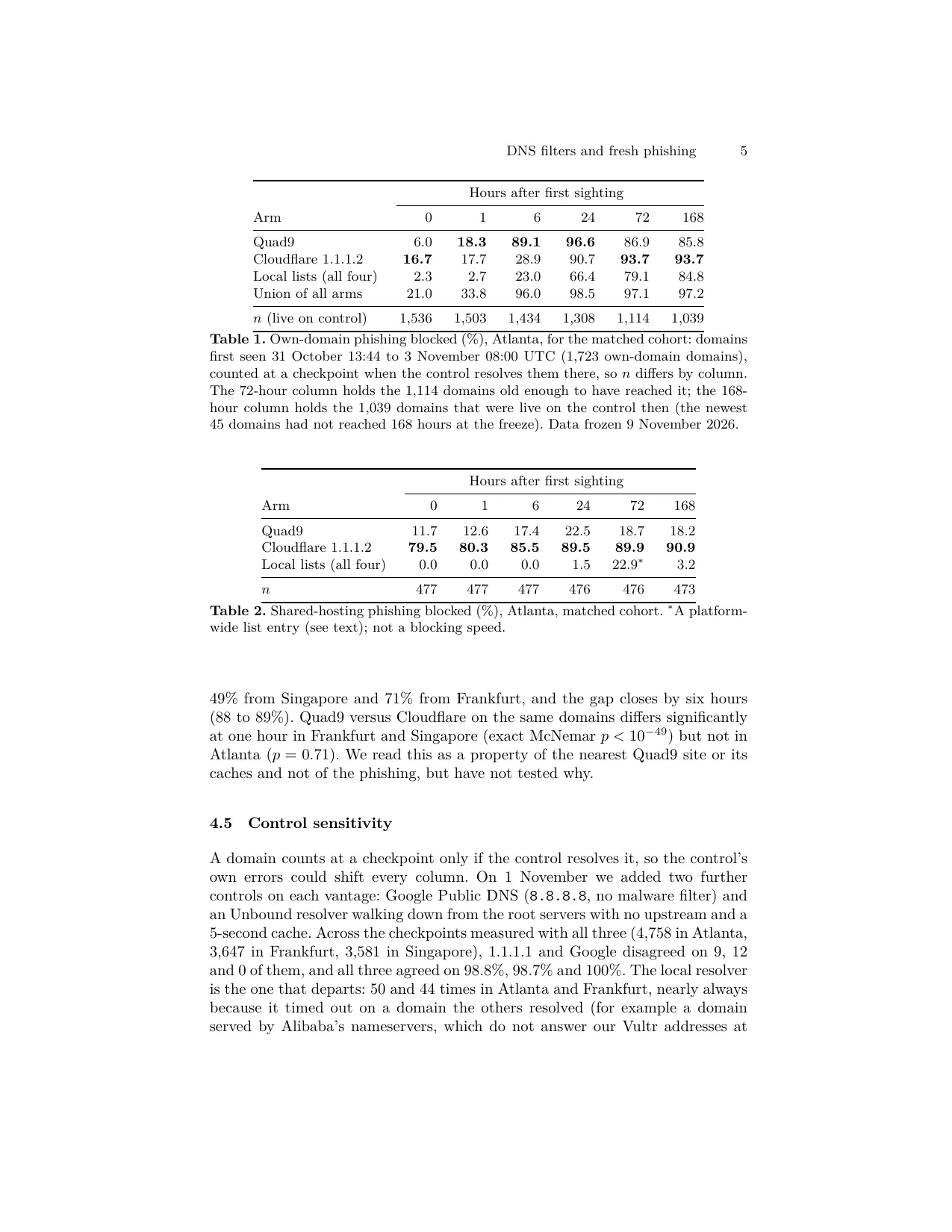
The table is Atlanta, own-domain phishing (1,723 domains), share blocked:
| After first sighting | 0 h | 1 h | 6 h | 24 h | 72 h | 168 h |
|---|---|---|---|---|---|---|
| Quad9 | 6% | 18% | 89% | 97% | 87% | 86% |
| Cloudflare 1.1.1.2 | 17% | 18% | 29% | 91% | 94% | 94% |
| Four blocklists | 2% | 3% | 23% | 66% | 79% | 85% |
Highlights
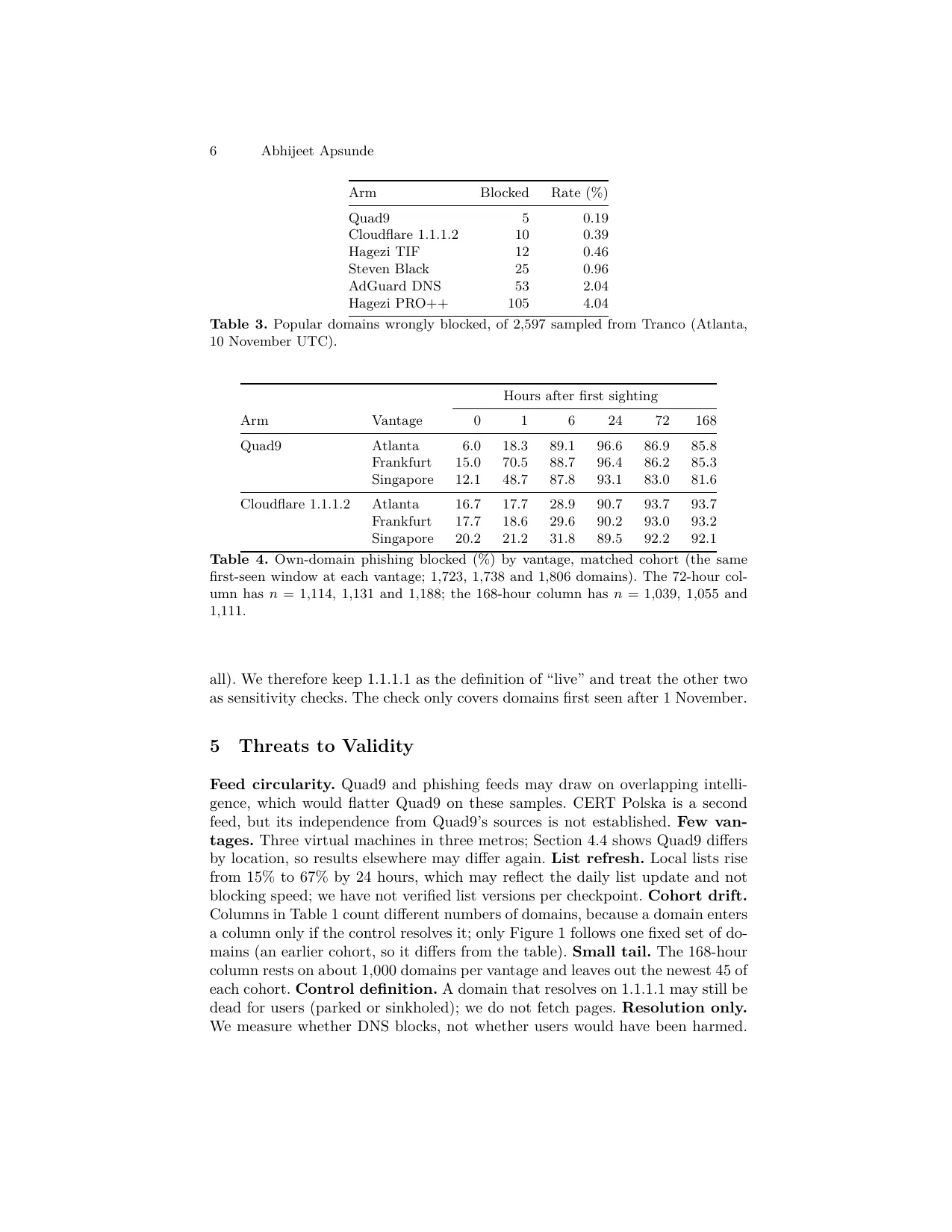
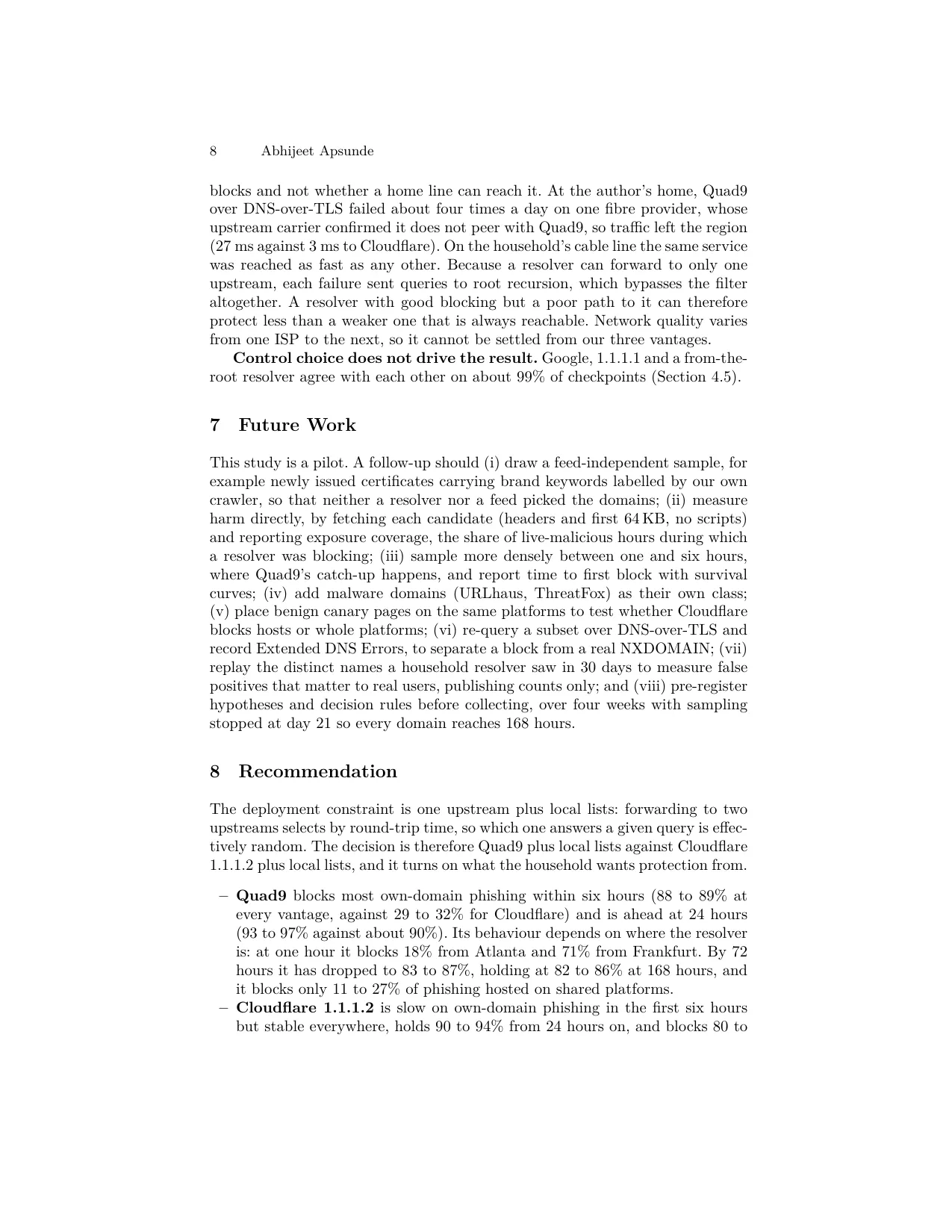
- The answer depends on where you ask. One hour after first sighting, Quad9 blocked 18% of the domains from Atlanta, 49% from Singapore and 71% from Frankfurt. Cloudflare stayed within 18% to 21% at every location. A test run from one city can reach the opposite conclusion about early blocking from a test run in another.
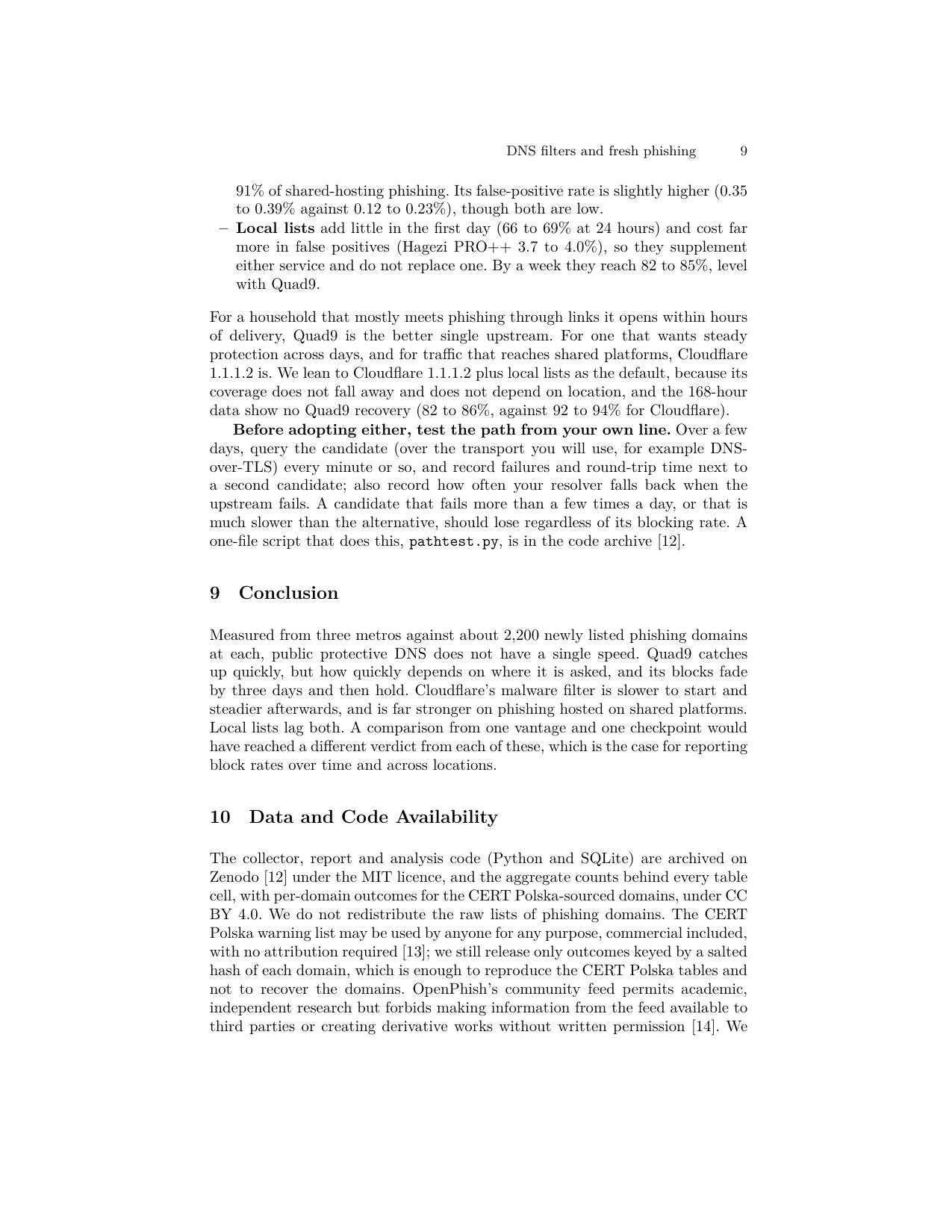
- The order flips at six hours. Cloudflare leads at first sighting (17% against 6% in Atlanta). By six hours Quad9 is at 89% and Cloudflare at 29%, and by 24 hours the gap is down to six points (97% and 91%).
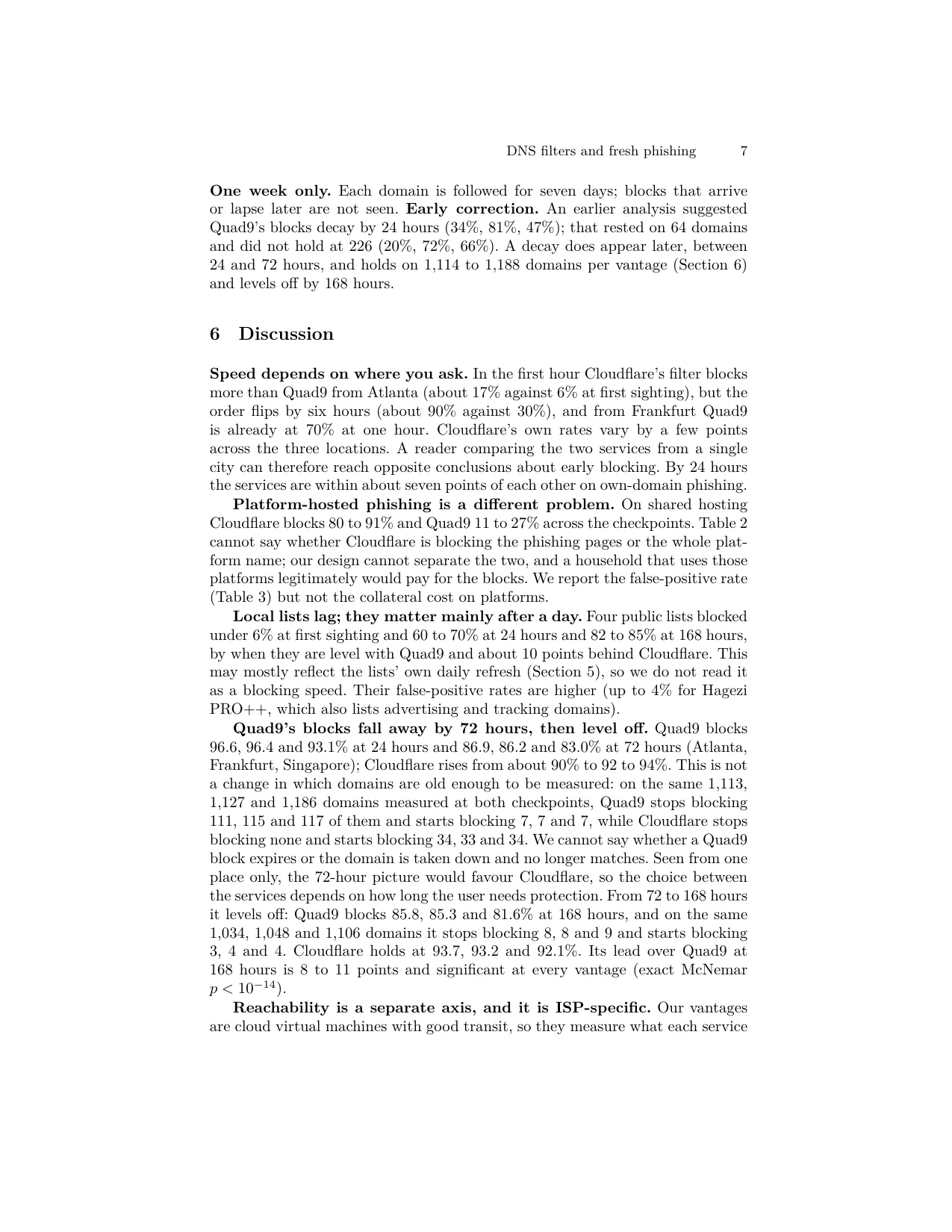
- Quad9's blocks fall after the first day, then hold. Between 24 and 72 hours Quad9 dropped from 96.6% to 86.9% on the same domains, and at 168 hours it was 85.8%. Cloudflare went the other way, from 90.7% to 93.7%, and held. At a week Cloudflare leads by 8 to 11 points at every location. I can't tell from DNS alone whether a Quad9 block expires or the domain gets taken down and stops matching.
- Shared hosting is a different problem. Phishing that lives on a shared platform (a pages.dev subdomain, for example) can only be blocked by blocking the platform name. On those, Cloudflare blocked about 90% and Quad9 about 18% to 23%. The design can't say whether Cloudflare is blocking the pages or the whole platform.
- Blocklists lag, then catch up. Four lists blocked 2% at first sighting and 66% at 24 hours, and reached 85% at a week, level with Quad9. Their false-positive rates are higher, up to 4% for one list that also covers ads and trackers, against 0.19% for Quad9 and 0.39% for Cloudflare on 2,597 popular domains.
- I was wrong once on the way. An early interim run said Quad9's blocks decay within 24 hours. That rested on 64 domains and did not hold at 226. The decay is real but it happens later, and the paper keeps the correction in the limitations.
- Reachability is a separate axis. These VMs have good transit, so they measure what each service blocks and not whether a home line can reach it. On one fiber line at my house, Quad9 over DNS-over-TLS failed about four times a day because the carrier does not peer with it. On the cable line the same service was as fast as any other. When the upstream fails, a resolver without a fallback ends up recursing from the root servers, which skips the filter entirely. The paper ships a one-file test,
pathtest.py, to run from your own line before choosing.
Limits
Quad9 says on its own site that one of its threat-intelligence providers ingests a list used in a test of it, so feeds and filters can share sources, and I can't rule that out for OpenPhish or CERT Polska. Three VMs in three cities are three vantages, and Quad9's behavior varies by location. The study measures whether DNS blocks, not whether anyone would have been harmed, and each domain is followed for seven days only.
Code and data
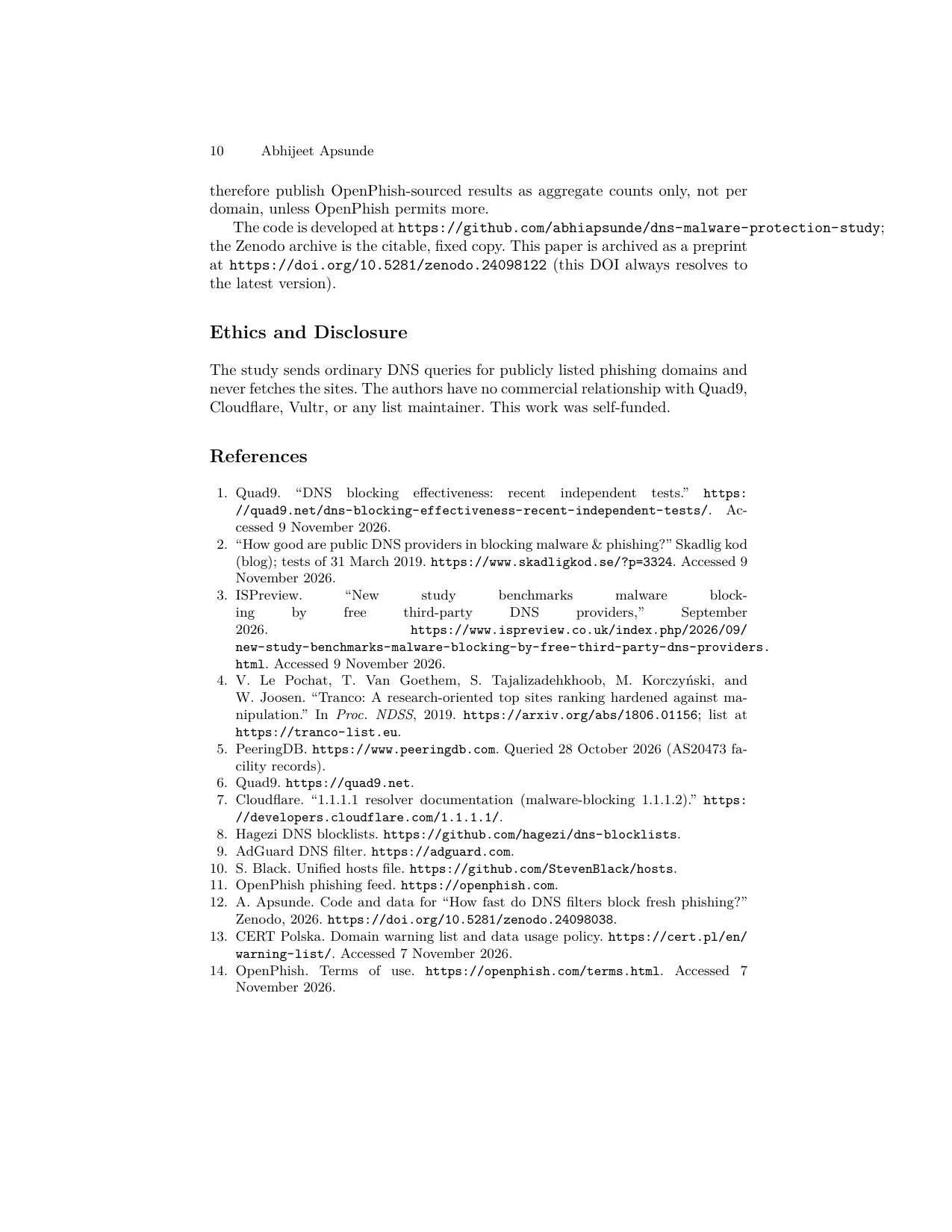
The collector, analysis code and the counts behind every table cell are archived on Zenodo under CC BY 4.0 and MIT (doi:10.5281/zenodo.24098038). Per-domain outcomes are released only for the CERT Polska domains, keyed by a salted hash. OpenPhish's terms don't allow passing its feed on, so its results are aggregate counts only.
The paper
Scroll inside the frame to read all 10 pages. Download the PDF (96 KB) for selectable text, or get it from Zenodo.
Cite this paper (BibTeX)
@misc{apsunde2026dnsfilters,
  title     = {How Fast Do DNS Filters Block Fresh Phishing? A Seven-Day, Three-Vantage Comparison of Quad9, Cloudflare 1.1.1.2, and Public Blocklists},
  author    = {Apsunde, Abhijeet},
  year      = {2026},
  publisher = {Zenodo},
  doi       = {10.5281/zenodo.24098122},
  url       = {https://doi.org/10.5281/zenodo.24098122},
  note      = {Preprint}
}